The Four Levels of AI Adoption for Small Businesses
By Nick Basile
I gave a talk this week to the AI foundations honor seminar at Franklin University Switzerland, and the moment I put this framework on the slide, the whole room leaned in. Not because the ladder is overly clever. It was because every student in the room could suddenly see where they were sitting, where everyone else was sitting, and what the next move actually looked like. The fog lifts when you can name the rung you’re on.
Here’s what I keep seeing out in the wild: most small business owners are stuck at the same level of AI adoption, and they have no idea. They have ChatGPT or Claude open in a browser tab. They type in questions, they get answers, they copy things back out, and they call that “using AI.” That’s a fine place to start. But it’s Level 1 of four, and almost all of the real leverage lives above it.
The good news is that you don’t have to guess where you are. The ladder is short. The rungs are concrete. Once you can see where you’re standing, the next move picks itself. So let’s put you on the ladder, and then let’s talk about how to climb.
The four levels
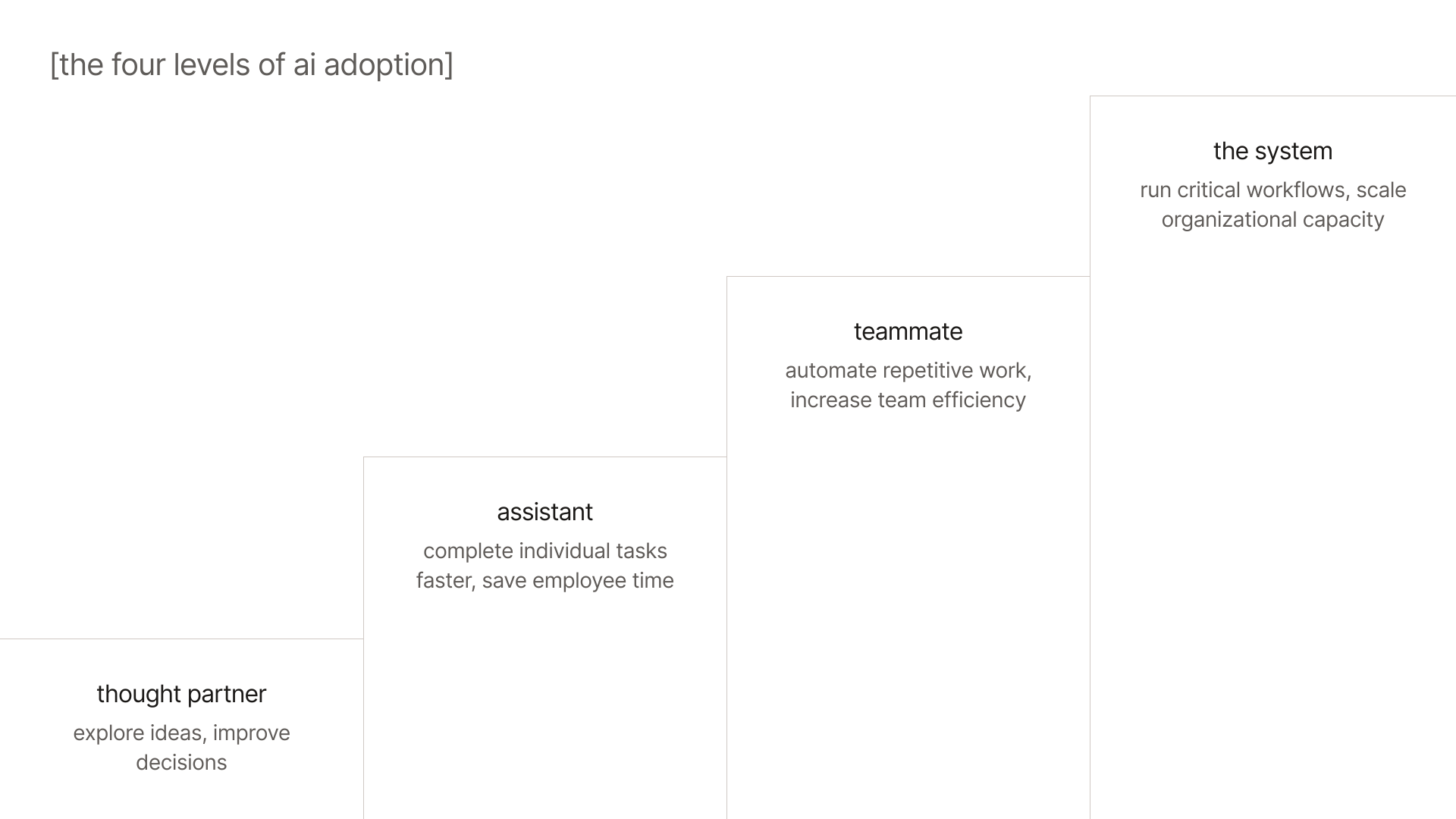
| Level | Name | What it looks like | Payoff |
|---|---|---|---|
| 1 | Thought partner | Manual, conversational chat. Asking questions, sharpening ideas. | Better thinking |
| 2 | Assistant | AI has skills. It completes discrete tasks end to end. | Time saved |
| 3 | Teammate | Skills + workflows + schedules. Repetitive work runs with a human in the loop. | Throughput increased |
| 4 | The system | AI runs critical workflows on autopilot with minimal supervision. | Capacity scaled |
Each level builds on the one before it. You can’t skip rungs, and you can’t drop Level 4 into your business if you haven’t figured out what a Level 2 skill looks like first. The reps compound, but only when you do them in order.
Level 1: Thought partner
This is where most small business owners live, and most of them don’t realize it. You open ChatGPT. You ask a question. You get an answer. Sometimes you paste in some context, sometimes you don’t, but the moment the conversation ends, the chat window closes and none of the work sticks around. Next time you need the same thing, you type the same setup back in from scratch.
Thought partner is genuinely useful for a narrow set of jobs. Brainstorming is one. Getting a second opinion is another. Asking something to explain a contract clause or a legal term you don’t recognize is a third. Drafting a rough version of something you’ll rewrite anyway is a fourth. If that’s the work, a chat box is the right tool for the job.
Where Level 1 breaks is the moment the task starts to repeat. The second time you find yourself typing the same setup into the same chat box to get the same kind of output, you’ve hit the ceiling. You’re not building anything. You’re pouring time into a system that doesn’t accumulate. The AI is smart; your use of it has no memory, no structure, and no compounding return.
Honest self-check: if every interaction with AI starts from a blank chat, you’re at Level 1. The work you did yesterday didn’t make today any easier, and that’s the defining feature of the level.
Level 2: Assistant
At Level 2, something changes in how you use AI, and it’s more about you than about the tool. You stop typing the same thing over and over. Instead, you write the workflow down once: what the AI should ask for, what steps it should take, what format the output should come back in. You save that written-down workflow somewhere, and from then on, you invoke it. That document is a skill.
A skill is not a tool you buy. It’s a markdown file, a Custom GPT, a Claude Project, or even a saved prompt template. The format isn’t the point. The point is that the knowledge of how to do the job lives in the document instead of in your head, and anyone can run it and get the same quality every time.
Think about a proposal drafter. You feed it the client name, the scope, and the budget. It pulls from your template, writes in your voice, and formats the thing the way you send it. Forty-five minutes of work compressed to five. Or picture a marketing skill that takes a topic and a keyword and hands you a draft in the exact shape you publish. Either way, the skill becomes the institutional memory.
The real shift at Level 2 isn’t speed — it’s who is moving the work. At Level 1, every keystroke runs through your fingers. At Level 2, the skill does the work, and your job is to decide what the skill should be. That’s the first real taste of leverage.
Honest self-check: if you’ve got one or two tasks where you’ve written the whole workflow down and the AI runs it from a single instruction, you’re at Level 2. Welcome to the meaningful leverage. For a deeper walkthrough on building your first one, see our guide to building a custom AI skill for your business.
Level 3: True teammate
At Level 2, a skill runs when you invoke it. At Level 3, the skills start chaining together, running on schedules, reacting to triggers, and handling the work without you being in the loop for every step. You become the reviewer. The work itself starts to run on its own.
This is the level where AI stops being a tool and starts feeling like a teammate. Not in a touchy-feely way, in a practical way: you give the teammate judgment at the top and a review at the end, and the work happens in between without you.
Our content pipeline at Markham Square is the example I reach for first. One skill generates the brief. Another writes the draft. A third pass repurposes the finished post into a LinkedIn post, a Twitter thread, a newsletter excerpt, and an email teaser. A fourth schedules the whole thing to publish. I show up to review the output and push it live. That whole loop used to eat 20 hours a week. Now it takes 1 to 2.
The difference from Level 2 is worth naming plainly. I’m not the one starting the work anymore; the work starts itself. The calendar triggers it, the skill chain does the job, and a finished draft lands in my review queue. My role has shifted from production to judgment. The output has multiplied. The hours haven’t.
Honest self-check: if you’ve got skills that chain together, run on a schedule or a trigger, and you show up to review rather than to start, you’re at Level 3. Throughput multiplies. Capacity opens up. Suddenly the week has room in it.
Level 4: System
Level 4 is where AI runs critical workflows on autopilot with minimal supervision. The human isn’t the one pressing “go” anymore. The system is.
The cleanest public example right now is agentic coding. Stripe has an internal system called Minions, and per their own engineering blog, it’s “responsible for more than a thousand pull requests merged each week.” Humans review the code before it ships, but the minions write it end to end. Thousands of pieces of production code a week, shipped by agents. That isn’t a tool; it’s a system.
We’ve built something similar at Markham Square. Our agentic coding setup ships production code with human review at the merge step, not at the writing step. And the marketing engine I described in Level 3 has pieces that live at Level 4 too: distribution runs itself, repurposing runs itself, scheduling runs itself. I’m not in the loop for any of those steps. If something broke, I’d notice because the output stopped showing up, not because I was standing over the pipeline watching it work.
This is a different planet from posting ideas into ChatGPT. The work runs without me. It produces real output at real scale, and the humans in the loop are there for judgment calls and quality checks, not for production.
The mental shift at Level 4 is the biggest of the four. You’re not the worker anymore, and at some points you’re not even the reviewer. You’re the architect of a system that runs work while you’re asleep. The AI isn’t helping you do the job; it is doing the job.
Honest self-check: if there’s a workflow in your business that AI runs without you starting it, without you reviewing every step, and the only way you’d notice it was broken is that the output stopped showing up, that’s Level 4. Most businesses don’t have this yet. The ones that do are moving much faster than the ones that don’t.
Almost everyone is at Level 1
Here’s the uncomfortable truth that lands in every room we present this in: the vast majority of people are at Level 1. Not most. Not a lot. The vast majority. They hear “thought partner” and say, “sure, I’m past that, I use AI for real work.” Then we dig in, and it turns out they type the same setup into ChatGPT every Monday morning, they’ve never written a skill down, and they’re still sitting at Level 1.
That’s not a failure. It’s the starting point, and it’s the starting point for almost every business in America right now. But naming it matters, because the move from Level 1 to Level 2 is the single biggest unlock you can make. Bigger than Level 3 to Level 4, honestly. The first skill you write down is the moment AI stops being a chat buddy and starts being part of how your business actually runs.
If you only take one thing from this piece, take that one: the climb is really about getting from Level 1 to Level 2. Everything after is gravy.
How to climb
The move is always the same shape. Pick the next level up from where you actually are. Install one thing. Ship it. Then look at the next rung.
- Stuck at Level 1? Pick the most repetitive task you do in the chat box. Write it down as a skill, front to back. Run it. Revise it until it’s reliable. That’s Level 2.
- At Level 2 with one or two skills running? Pick two skills that naturally run back to back. Chain them. Add a trigger (a time of day, an inbox, a form submission) so the first one starts itself. That’s Level 3.
- At Level 3 with a working pipeline? Find the step in the pipeline where your review has become a rubber stamp. Take yourself out of that step. Let the system run. That’s Level 4.
You don’t skip levels, and you don’t need to install all four in a month. The businesses pulling ahead of their competitors aren’t the ones with the fanciest Level 4 setups; they’re the ones who climbed one rung, proved it, climbed the next one, and never stopped. Every skill you write down and every workflow you automate compounds on the one before it.
The Wrap-Up
The four levels aren’t a scoreboard; they’re a map. Thought partner is a fine place to start. It’s the on-ramp, and every business that ends up at Level 4 started at Level 1. The trap is staying there.
Take a minute and put yourself on the ladder. Don’t round up. Be honest about where the work is actually landing today. Then pick the single next move: the first skill to write down, the two skills to chain, the step where your review has quietly gone from useful to ceremonial.
Pick the rung above you. Install one thing. That’s the whole game.
If you want to see what this looks like in practice, our guide to using AI for small business marketing walks through a real Level 3 pipeline end to end. And if you’re at Level 1 and ready to build your first skill, start here: how to build a custom AI skill for your business.
As always, feel free to ask me any questions on LinkedIn. And until next time, happy building.